Use a supported Blender 5.x release.
From installation
to your first production Bake.
Cloth NeXt keeps setup, materials, validation, baking, recovery and playback inside Blender. This guide covers the supported workflow from installation to final cached results.
Requirements
The current production workflow targets Windows.
A compatible NVIDIA GPU is required for simulation.
Scene capacity
Practical scene size depends on VRAM, system RAM, topology, contact count, animated samples, quality and frame count.
Install Cloth NeXt
- 1Download the product ZIP
Keep the extension archive intact. Do not extract it.
- 2Open Get Extensions
Go to
Edit → Preferences → Get Extensions. - 3Install from Disk
Open the repository menu, choose
Install from Disk, and select the ZIP. - 4Enable Cloth NeXt
Enable the extension and restart Blender whenever Blender requests it.
Install the solver from Cloth NeXt
The solver is not included in the add-on ZIP, but can be installed directly from the add-on preferences.
- 1Open Cloth NeXt Preferences
Find Cloth NeXt under Blender's installed Add-ons.
- 2Start the guided installation
Choose the managed solver installation option shown in the preferences.
- 3Review and confirm
Cloth NeXt shows the compatible release and asks for confirmation before installation.
- 4Run Solver Health Check
A compatible protocol and schema marks the solver Ready.
Managed setup
Cloth NeXt downloads, verifies and configures the selected compatible solver installation from the preferences.
Your first Cloth Bake
- 1Prepare the mesh
Use clean, constant topology and intentional object scale.
- 2Add the Cloth role
In Physics Properties, add Cloth NeXt and select
Cloth. - 3Add a Collider
Enable Cloth NeXt on the collision mesh and choose
Collider. - 4Choose material and quality
Start from a material preset and use a lower quality tier while iterating.
- 5Validate and Bake
Resolve Scene Health messages, set the frame range, then start the Bake.
Build one interacting scene
Cloth
A surface mesh simulated as fabric. Multiple garments can participate in one solve.
Collider
A static or topology-preserving animated contact surface.
Rod / Cable
A Curve simulated as a one-dimensional deformable with a uniform physical radius.
Soft Body
A closed volumetric deformable using automatic internal tetrahedralization.
Rigid Body
A rigid simulation object that participates in the shared contact scene.
Force
A keyframeable Empty used for gravity, wind and supported air behavior.
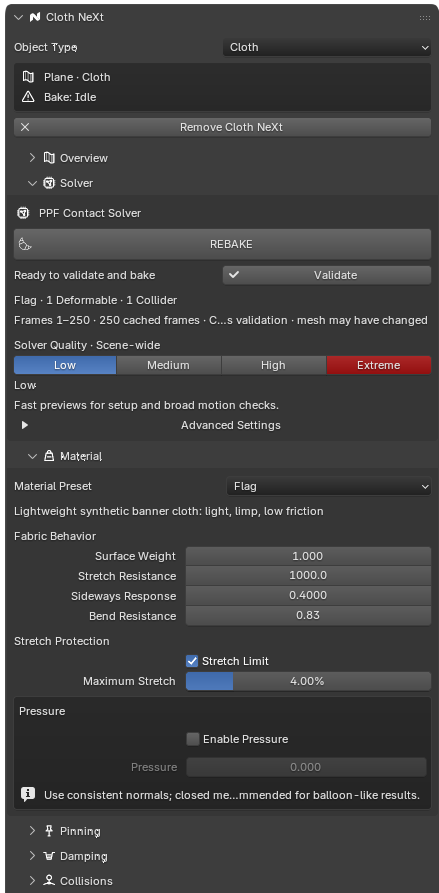
Start with one of 75 material presets
The material library provides categorized starting points for common fabrics and flexible materials. Presets fill artist-facing controls for surface weight, stretch response, sideways response, bending, friction and stretch protection. Editing a value keeps the preset as a starting point and moves the material into a custom state.
Fast setup checks and broad motion tests.
Balanced iteration with stronger contact handling.
Final-oriented settings for demanding scenes.
An expensive last-mile profile for difficult shots.
Attach cloth without freezing the performance
Create a Blender vertex group on the deformable and assign it as the pin group.
Hard Pins
Keep selected vertices fixed to their static or animated target.
Soft Pins
Maintain attachment while allowing controlled movement and a softer response.
Animated targets are useful for rig-driven waistbands, cuffs, collars, straps and other attachment areas. Evaluated topology must remain constant throughout the Bake range.
Control collisions and surface behavior
Friction controls how easily surfaces slide. Surface Offset represents simulated thickness. Collision Gap controls when contact response begins. Animated colliders are sampled from evaluated Blender geometry.
Use intentional collider topology
Dense animated colliders multiply preparation time and memory use across captured samples. Use the full character when accuracy matters, or a purpose-built collision cage when faster setup is more useful.
Create faster character collision proxies
Character Collision Cages create animation-aware proxy geometry around a rig. The generated structure stays visible and editable in Blender, making it useful for heavy characters where simulating against the full mesh is unnecessary.
- Per-bone collision structure
- Animation-aware proxy generation
- Reusable evaluated data
- Optional workflow, not required for every character
Animate gravity, wind and air response
Add an Empty, enable Cloth NeXt and choose the Force role. Supported gravity, wind and air controls can be animated through normal Blender properties and are evaluated with the rest of the Bake scene.
Know what the Bake is doing
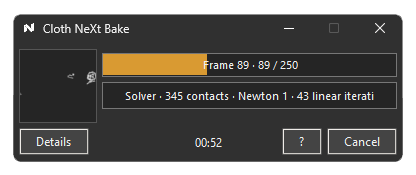
The Bake Companion reports the current frame, total progress, solver activity, estimated timing and system load.
- Results are written as versioned object-local playback caches.
- Incomplete output is never presented as a finished result.
- A failed Rebake preserves the previous valid result.
- Clear Result removes only Cloth NeXt-owned files and playback.
Resume instead of starting from frame one
When a valid checkpoint survives an unexpected solver exit, Cloth NeXt verifies that the recovery data belongs to the active scene and compatible solver installation before offering Resume from Latest.
Recovery is verified before use
Invalid, incomplete or incompatible checkpoints are not presented as resumable results.
When a Bake fails
- 1Read the CNX code
The Bake Companion and Blender show a stable code such as
CNX-E161. - 2Follow the displayed guidance
The error state names the likely cause, affected stage and recommended first action.
- 3Run Scene Health
Check geometry, storage, compatibility, memory and solver readiness.
- 4Retry after correction
Fix the reported issue, then start a new Bake or resume from a verified checkpoint when available.
Important limitations
- Windows x64 and a compatible NVIDIA GPU are currently required.
- The solver is intended for offline production simulation, not real-time playback.
- Topology-changing deformation across a Bake is rejected.
- Playback requires constant vertex order and vertex count.
- Rod / Cable currently uses a uniform simulated collision radius.
- Soft Body requires a closed manifold mesh.
- Capacity depends on topology, contacts, samples, quality, VRAM and RAM.
- The solver is not included in the add-on ZIP and is installed from the add-on preferences.
What to include in a support request
Run Scene Health and choose Export Privacy-Safe Report. Send the report with the visible CNX error code, Blender version, GPU model and short reproduction steps using the support contact on the Superhive product page.
Your scene stays private
The report excludes mesh geometry, object names, file contents and full filesystem paths.